

Greetings from the Big Apple! I’m back in NYC for a quick two-day work jaunt, before heading out for three weeks in Asia. The next month will feel chaotic, but in a good way, so more to come.
Longtime readers may remember I joined my first group tour as a solo traveler several years ago (I shared about the experience here). The big draw for me? The connections on the ground with small businesses, Indigenous co-ops, and women-run organizations. There was frankly no way I could have built those relationships on my own, or coordinated logistics to that rural part of Oaxaca. It was well-worth the investment.
Intrepid Travel is another longtime tour operator, with 35+ years of experience and 900+ trips around the globe. In 2018, the team began running Women’s Expeditions, sharing: “This is an exciting opportunity for our female travelers to learn about the customs, challenges and lives of women around the world; to immerse themselves in local experiences that have been otherwise off-limits to our regular group departures.”
For the 2026–2027 season, Intrepid recently announced the launch of three new Women’s Expeditions to Peru, Cambodia, and Bhutan. Similar to other offerings, these trips are “led by local female trip leaders and feature immersive, women-led experiences that support women-owned businesses and break down long-standing gender barriers in tourism.”
Intrigued by their nuanced approach, I had the opportunity to chat with Erica Kritikides, the General Manager of Experiences at Intrepid. We spoke about the state of solo women’s travel, how they curate these slow and sustainable trips, and how they collaborate respectfully with those facing structural barriers.
If you’re interested in booking a trip with Intrepid, the team has gifted Departure readers a $100-off offer with code “750722” for new bookings, made and deposited between 12:01am EST March 16, 2026 to 11:59pm PST April 30, 2026, for select trips departing between April 16, 2026–December 15, 2026, unless otherwise specified. (This is not sponsored and I do not receive any compensation if you book—it is simply a generous offer on their part.)

Erica, you noted 77% of travelers are booking the “Women’s Expeditions” solo. Is this a more recent surge post-Covid, or was this a long time in the making?
Intrepid’s always had a high proportion of female travelers. Over 60% of our travelers are women. What’s changed since the pandemic is people’s desire to get out there. When people couldn’t travel, it was a real understanding that you couldn’t take travel for granted. Post-COVID, we have seen an increase in solo female travelers—a 10% increase year on year, from 2024 to 2025.
What other demographics are you seeing as a trend? Are these women in a certain age range? Do they share why they’re pursuing solo travel?
We are seeing a strong increase in solo female travelers in the 45+ age category; the average age of our Women’s Expedition travelers is 49.
One example is a woman called Laurie, who, at the age of 86, lost her husband very sadly. But she just felt the time was right to get out, and was encouraged by her son. Her first trip she chose to do was a Women’s Expedition in Pakistan. One of the takeaways from Laurie was that realization that there’s just so much out there and that you don’t need to wait around for someone. It’s really nice to see women prioritizing themselves.
A small group adventure, such as what Intrepid’s able to provide, is the perfect vehicle for people to have that immersive experience, while still having that safety blanket of knowing you’re traveling with a company that can get you from A to B, and traveling with other people who are like-minded. That’s absolutely core to these Women’s Expedition experiences—people traveling with other women from around the world, whilst meeting and connecting with other women in the destinations where we’re traveling to as well.
Your team shared, “We’re intentionally choosing destinations where tourism can create meaningful economic opportunity for women. When women succeed in tourism, it strengthens families, communities, and entire local communities.” We know this to be true about women’s economic empowerment as well: Research suggests that up to 90% of women’s income gets reinvested into their families and local communities, as opposed to 30–40% from men. Can you share any firsthand stories of this in action?
You’re right to say we’ve been really intentional about where we’ve established our Women’s Expeditions. They do tend to be in destinations where your more “traditional” social norms prevail, and there might be barriers to full female participation in public life or in the workforce.
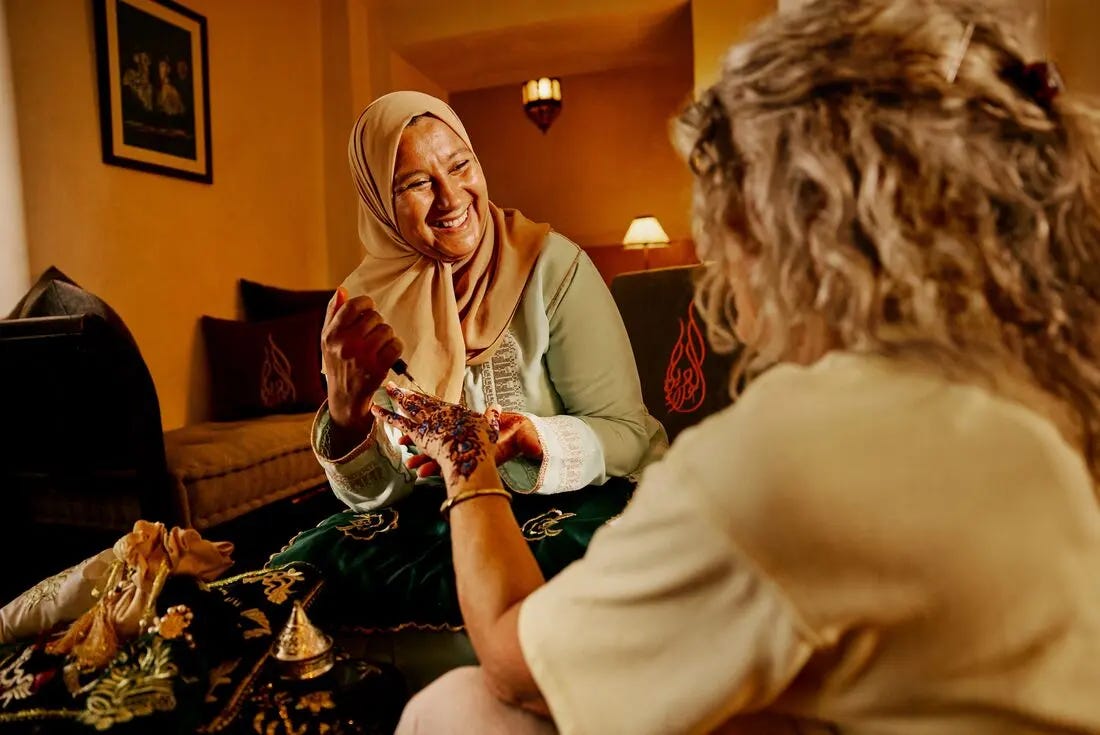
We see our Women’s Expeditions as a really exciting opportunity for not only our female travelers to go behind those closed doors and learn about customs and challenges and everyday lives for women in those destinations, but also that opportunity to provide employment, opportunities to support female owned businesses, opportunities to support female leaders and development in the destinations where we travel.
As of October 2025, we’ve got about 36% of female leaders across Intrepid Travel. And by 2030, we’re aiming to bring that up to 40% across the board; with our Women’s Expeditions, obviously all of our trips are led by local female leaders. We’ve taken a lot of time to make sure we are building very deep and impactful supply chains and connections with those women.
One of the first ones that comes to mind is a fantastic company in Jaipur called Pink City Rickshaw. Pink City Rickshaw effectively employs women as tuk-tuk drivers, but also shows them how to manage the mechanics of their vehicles as well, with the intention of providing a service, not only for women traveling around Jaipur who may want a female driver, but also providing these drivers with a pathway to financial independence as well.
Today, they’ve got upwards of 200 drivers now on these tuk-tuks. We engage with the Pink City Rickshaw Company for a fantastic female-led tour of Jaipur where you not only zip around, see the sites of the city, but you also get to hear the story of your driver as well, which is really what our trips are very much about.
It’s not just about that surface-level of employing females, but also allowing the platform for them to tell their story as well. Recognizing the diversity of the female story across all of the different destinations where we’re traveling.
I appreciate that your team at Intrepid is taking a nuanced look at destinations where “women face structural barriers to equal participation in tourism.” How are you balancing the challenges women often face with being told to stay home for unpaid labor or at risk of gender-based violence? How does that play a role in identifying the countries you choose to work with?
These trips have been a really exciting vehicle to open up certain employment channels that have traditionally been considered very male-centric. So if I think about our Women’s Expeditions in Nepal, Morocco, Bhutan, and Peru, trekking is a very common and popular activity in tourism.
Trekking has long been considered a male dominated profession, whether you are a trekking guide or a porter. With our Women’s Expeditions in these four destinations, what we are really proud of is, we’ve been able to build teams of female porters, and provide support and employment channels for female tracking guides. In Peru, our locally based operations teams were actually led by a couple of women who were some of the first female trekking guides on the Inca trail many, many years ago.
Now the other layer to your question is, well, what does it mean when we’ve got women who might be based at home with [unpaid] responsibilities around family, and how do they participate? How can we leverage tourism and these Women’s Expeditions in particular to recognize those particular circumstances? The beauty of the Women’s Expeditions is that we’re able to incorporate experiences that actually celebrate these types of skills, whether it’s around hospitality, home-cooked meals, etc. within the trips themselves.
I was very lucky to join a Saudi Arabia Women’s Expedition in December last year. As part of that experience, we visited a lady called Fatima. Fatima is a mother of four, and she’s a very proud grandmother of two. We met Fatima in her wonderful living room in Riyadh, and Fatima served us a fabulous home cooked meal and we then just got to chat about her life, what it’s like to be a woman in Riyadh.
Now, Fatima has never been involved in tourism. In fact, she only started doing this job post-COVID. She absolutely loves the fact she’s able to earn an income that provides her with a level of financial independence and that she can be celebrated for something that she’s been cultivating her entire life. Looking after people, providing hospitality, is such a joy to her.
It’s also allowing her to interact with these people from all over the world within her own home, which makes this a really special experience that is accessible to her without even having to go out on the road, so to speak.
Do you ever deal with pushback from women’s families of, “No, this isn’t something she should be doing?”
In almost every destination where you find an Intrepid trip, it’s an Intrepid team on the ground operating those trips, and we’ve been navigating that issue that you’ve just articulated for many years.
It is very much a case of breaking down those stereotypes, particularly with tourism guides being male, in leading by example. I can think of, over the many years I’ve worked at Intrepid, the various female guides that have really been trailblazers in their fields and sort of been those people that have shown the way, shown that this is a possible career path.
It’s not always easy, and yes, in many destinations where we operate, there are challenges, perceptions that this is not a woman’s work. But it’s only by encouraging women to get involved and by others seeing them do that work by their families, being fulfilled, seeing that they can do that work safely, that we are starting to change perceptions, break down those barriers.
It is very much a gradual process. It doesn’t happen overnight. And it does require constant attention, which is why we have set a target around this for 2030 to ensure that we’ve got 40% of our leader base as women—because you do need to constantly be thinking about it and be proactive.
How are travelers prepared for and educated on these trips? How do you combat the “White Savior Complex” mindset and bring in that level of perspective, particularly since Intrepid’s executive leadership and core team are primarily not from these regions?
I really appreciate the upfront question on that and look, I think that is important to talk about it. Our experiences are created by our Intrepid teams on the ground who are all local to the destinations where we’re traveling to.
For instance, in Cambodia (our newest trip), our Cambodia team is run by a very inspiring lady called A. Our head of experience design, Makara, is a woman, etc. so we have locals on the ground helping us design our trips.
That’s obviously fantastic for our customers because they’re getting that real-time local expertise and knowledge on the ground. But it does really, to an extent, protect us against that “White Savior Complex,” because we are very intentional in ensuring our customers have an experience that’s through the eyes of locals, not through the eyes of an outsider.
That’s absolutely core to the way that Intrepid operates and the experiences that we want our travelers to have with the Women’s Expeditions. That way, travelers are able to meet other women from that community. They’re able to get that unique insight on what it’s like to be a woman in these destinations. They’re able to facilitate those conversations in local language, and on local terms as well. And I think that’s critical.
Every destination is nuanced, and for us, these trips are very much about providing the opportunity to break down cultural stereotypes, but allowing people of that culture, and in this instance, women in this culture, to break down those stereotypes on their own terms. Be able to tell their own stories directly.
How long is the process of developing these new itineraries, identifying women-led organizations, etc.? What is that exploration and research phase like? There are much smaller, boutique tour operators who also do tours like these at much higher price points—why should travelers consider Intrepid?
Can I tell you, actually, in reality, it takes years. In the instance of our three new trips—Cambodia, Peru, and Bhutan Women’s Expeditions—from a technical standpoint, they’ve probably taken about 12 months, but the research and development that’s gone into them are a result of Intrepid having been working in those destinations for many years. A number of those experiences are with people we’ve been partnering with or talking to for five, six, 10+ years.
When we talk about experience design, everything we do starts with our mission, which is to create positive change through the joy of travel. So we consider every part of that experience ecosystem. We are thinking about our travelers, tour leaders, our suppliers, the communities we partner with, and the environment we’re traveling through. It’s really important to have that at the outset when we’re talking about what goes into research and development for a trip.
In terms of value: It is really important to us that we are giving back adequately to the communities where we’re traveling to, so it is really important to acknowledge that. But Intrepid is also a business, and at our size, we’re able to offer a scale across our operations and that helps us provide affordable value to our customers.
We really do want our trips to be accessible to the broadest range of people possible. More broadly, Intrepid has multiple levels of accommodations and trips, so we have anything from a basic style of travel, which is two and two-and-a-half star travel, all the way through to our premium level, which is four to five-star. We provide multiple different price points for travelers in order to ensure that we are providing broad accessibility, as well as meeting what we recognize are different preferences when people travel.
I particularly appreciate that your trips range from eight to 13 days, because that feels like a substantive amount of time in one place. There are often many moving parts—going between different cities, several days hiking, etc. How much downtime do you allow for in your itineraries?
You’ve just described our traveler, basically. People are looking for a level of structure that allows them to get from A to B efficiently. That includes the key sites, places they might not be familiar with, and experiences they may never find on their own.
But we are called Intrepid Travel. We still want people to have an intrepid experience and get out there and find things for themselves as well. We often find, particularly after new travelers have been on a trip for one or two days, they’ve got that confidence they want to get out and, and explore themselves.
We pay close attention when we are designing an itinerary to what we call “pacing” and we do place careful attention on ensuring people have enough time in the places where we travel to. So we are generally looking at a minimum of two nights. And when we are talking about free time, by and large, we try and allow for a half day of free time for each two days of travel.
We are very responsive to feedback, and travelers provide us often with some really good insight into what they’re looking for from a pacing standpoint. What we can see from our Women’s Expeditions is actually on those trips the travelers are looking for more inclusions. They love the fact that there is a lot more to do on a Women’s Expedition. They’re very keen to delve into those experiences and to come together as a group.
We know that travel carries a heavy carbon footprint. While perusing a trip on Intrepid’s site, readers can clearly understand their climate impact and how you’re working to be as sustainable as possible. I very much appreciate your status as a certified B Corp (so you prioritize “planet” and “people” as much as profit) and you’re carbon-neutral. I also noticed you include the carbon footprint of travelers’ flights in/out of the destinations, even though that’s not a “hard cost” you’re responsible for. Why is that? How else are you thinking about sustainability?
This is a simple equation. As a travel business, we depend on the health of the planet. Climate change is impacting our people, the communities, and the places that we want to explore, that we love to explore. So it’s not an issue we can ignore.
Intrepid has always shown itself to be a leader in this space. We were one of the very first companies back in 2010 to start carbon-offsetting as a business. We are constantly evaluating: Are we taking the right approach? Are we taking the best approach to sustainability and particularly, these days, to carbon action?
As you’ve just said, we’ve introduced carbon labels to more than 800 trips. That helps our travelers make informed decisions, and providing that information is really important. Speaking from an experience design standpoint, we’ve also reduced the number of internal flights on our trips and that recognizes that flights are, by and large, the biggest carbon outputs on our products. And that’s now part and parcel of our product development process. We scrutinize flights incredibly carefully before they will go into an itinerary.
Last year, Intrepid announced a pretty significant shift in how we are approaching climate action. We’ve moved away from carbon offsetting, we’ve moved away from science-based targets, and what we are moving towards is a $2 million Climate Action Fund and an accelerated decarbonization plan. What that means is that, by 2030, we are targeting an eight percent reduction in carbon intensity across the business, and we are measuring that on a lifecycle basis. That includes the flights of the people to and from the destinations they’re traveling to.
Now you’re right to call that out, because that’s a lot of additional carbon that we are now accounting for and what we’re measuring, but it is the true carbon impact of the product that we offer, because people do need to fly to get to and from the destinations. So it’s very important that we’re actually facing this in a real life sense, and we are looking at the Climate Action Fund that’s going to invest money into projects to cut emissions and deliver value.
What that might equate to in real life is transitioning offices and hotels to a hundred percent renewable energy. It might be switching our vehicles to electric vehicles. It might be supporting our supplies to decarbonize by sourcing lower carbon fuel alternatives, for example.
Alongside that, in terms of cutting our own emissions, we’re also looking at how we can support nature-based. Initiatives. So by 2030, we’re also looking to fund 10 transformational projects in the places we operate around reforestation, regenerative agriculture, wildlife conservation, and ecosystem restoration.
This new approach is more real in terms of recognizing the extent of the challenge we face, but it’s also far more directly impactful in terms of what we are looking to do. It’s certainly going to require a huge amount of work. This is not an easy target to hit, but we’re incredibly committed to it as a business to hitting it. From an experience design standpoint, this will be something that my team will be focused on very closely, as we move into the future.
How does that work internally? Do you have sustainability consultants you’re working with, or do you have employees on the team that this is their sole focus? What does that look like in practice?
Intrepid has a General Manager of Climate, and we do have a team that she is supported by. We’re very lucky to have Dr. Susanne Etti, who has incredible credentials in this space, and we are taking a very scientific and intentional approach to setting this strategy.
Finally, if you could only pick two Women’s Expeditions to share with Departure readers for the next year, which would they be?
I’m really proud of the new trip that we are launching in Peru. The Women’s Expedition in Peru obviously takes in some key highlights; you know, people will be able to experience the beauty and the mystery of Machu Picchu, which is undoubtedly one of the highlights.
But the experiences within that trip for me are the real highlights: There are a number of different day trips led by a growing team of female porters and female mountain-trekking guides. Having had the pleasure of meeting a number of them, I can say that our travelers are in outstanding hands as they go and experience the true beauty of what it is to hike through the Andes.
You will experience a shaman ritual thanking Pachamama, the mother earth, in a traditional ceremony. So often, we think of religious heads or ceremonial heads as men. So it’s really exciting to see that experience being led by a woman shaman.
You’ll also have the opportunity to visit communities in the Sacred Valley where you’ll be able to take part in traditional crafts such as bracelet making with local women; these are intergenerational communities where you can genuinely see the benefits of tourism in how much things have changed for those communities over time and for each generation there, and it’s very interesting to hear those stories.
We also support a wonderful local enterprise, called the Ama Restaurant, where we take part in a delicious chocolate making activity. This restaurant’s very special insofar as it employs women in the way that they can also bring their children along to the restaurant as they work. This is a restaurant that’s very much about supporting women and meeting women where they are in life, whilst also providing those employment opportunities.
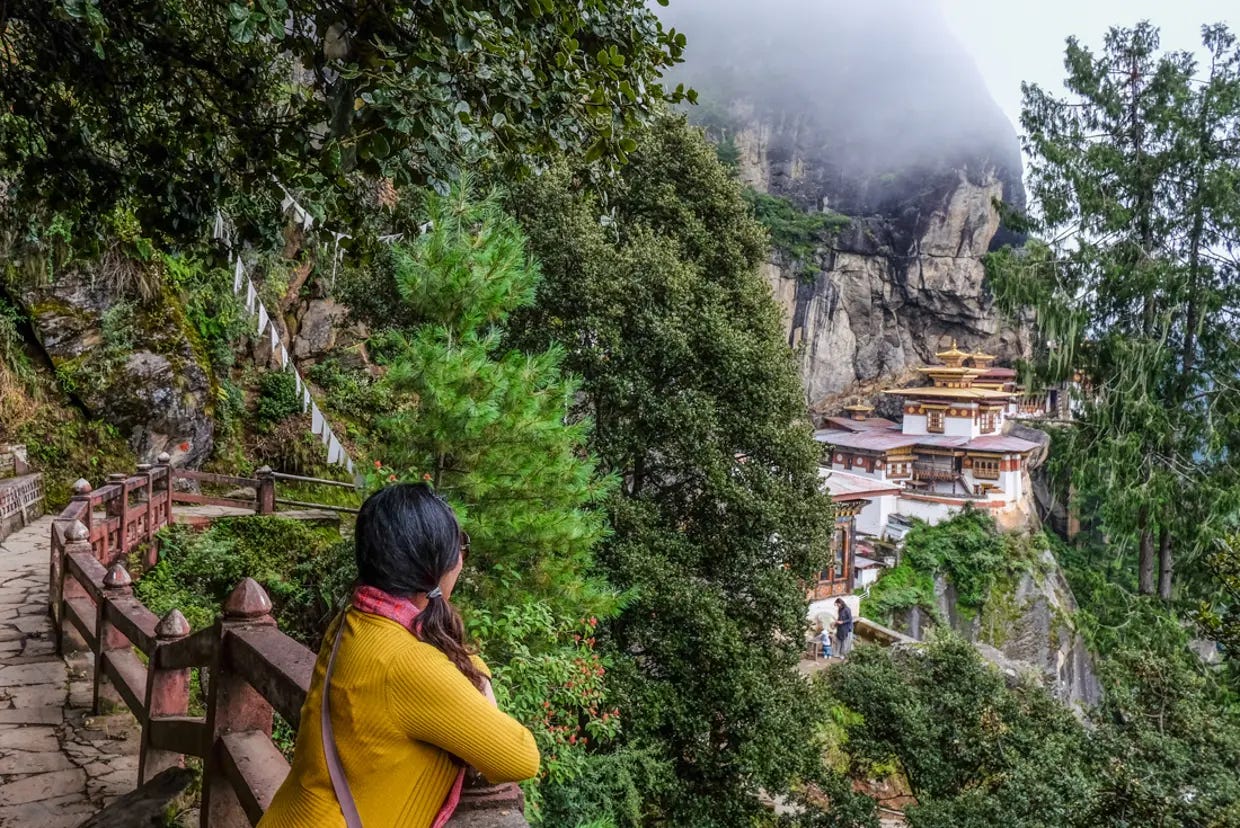
As for our Bhutan Women’s Expedition, you will take a magnificent hike to Tiger’s Nest monastery. Again, you know, it’s really exciting to see the development of our female trekking crews—I think we’re now at 50% of leaders in Bhutan are women. [We ran out of time to dig further into this trip but per their website, other highlights include: Distilling your own traditional Bhutanese spirit, having a hot stone bath at a female-owned farmhouse, meeting local nuns to learn about monastic life, and stay at a female-owned and operated hotel in Thimphu.]
—
Again, if you’re interested in booking a trip with Intrepid, the team has gifted Departure readers a $100-off offer (code “750722”) for new bookings, made and deposited between 12:01am EST March 16, 2026 to 11:59pm PST April 30, 2026, for select trips departing between April 16, 2026–December 15, 2026, unless specified.

🚊 Did you know that Cincinnati has an abandoned subway line underneath the city? I always find underground transit fascinating—so much so that I once took a tour of abandoned subway stations in NYC. Insert something about, “If we wanted to build affordable public transit systems here, we could.” (c/o HIMBy)
🔝 TIME released the “World’s Greatest Places of 2026.” Interesting that they waited until mid-March to release this, but the recommendations are highly specific; think hotels, restaurants, and landmarks, as opposed to a general destination. For that reason, there are valuable hidden gems.
❤️ Kyla Egan, a writer with a background in destination consulting and tourism, just launched a Substack and I’m eagerly awaiting every post. She describes Making Places as “for the curious traveller who finishes a trip wanting to know more. The economics behind why a neighbourhood feels the way it does. The person whose vision, stubbornness, or sheer refusal to sell shaped the place you just walked through. The signals and frameworks that help you read a destination honestly rather than consuming the version of it that was designed for you.” Her first post alone is worth subscribing.
🌎 “Sick of the world, but never sick of earth.” Click through. (c/o andrea)
👚 For my fellow capsule wardrobe friends: I recently restocked my Buck Mason tees (affiliate), and they are utterly perfect. The flattering fit, the 100% organic cotton fabric, and the quality are all incredible. I wear them almost daily while traveling. Size up!
See you next week—when I’ll be writing to you from Shanghai—for our next giveaway for paid subscribers. 🤩 —Henah x
Thank you so much for sharing! Intrepid is certainly a travel company that is leading the way, with a strong focus on social, environmental, and economic sustainability.
I loved this incredibly thoughtful interview - thank you for asking both the interesting and hard questions!