


At the start of this year, I decided to plan a 10-day solo trip across Europe. I wanted a challenge, sure, but I also wanted to give myself the gift of presence and time—unburdened by work or home responsibilities—after a very tough 2025. Booked six months in advance, I didn’t think much about the weeks leading up to my departure.
By late spring, I found myself feeling worn out and spread too thin: I was working full-time, writing this newsletter weekly, freelancing a podcast as an executive producer, volunteering with two agencies, and all the while, trying to be a good partner, pet parent, family member, and friend. I was becoming easily agitated, experiencing brain fog and overwhelm, and not sleeping quite as well. It was textbook burnout, and I eagerly began counting down the days until my PTO.
That 10-day trip quickly shifted from a sense of adventure to one of recovery. I spent much of my downtime in Italy and France journaling, reading, and napping for hours at a time. Slowly, I noticed my knots loosening and my mind unwinding. I wouldn’t say that I returned home recovered from burnout, but I did have enough energy to go back to my daily life for the foreseeable future.
When I shared about my experience, I heard from so many other women in my life that they’re experiencing high levels of burnout, too, particularly working parents and women in the C-suite, ages 30s to 50s. (Many of the reports I saw from this year stated between 40–60% of women feel this way, and an AXA report said, “Women’s mental health remains worse than men’s across every metric.”) This doesn’t even touch upon social media fatigue and screen-time, the state of the world, or other major life transitions women experience, like divorce, shifting to empty nesters, or joining the sandwich generation.
If research shows most women are burned out in one way or another, what can travel offer as a way to recover? I’ve openly addressed before the short-term respite travel allows me, but with a proliferation of “burnout and recovery” retreats and digital detoxes, I’m curious if these programs really help—and crucially—if they can offer sustainable solutions for when we arrive home. When I invited sources to reach out, I heard from over two dozen professionals: some who host retreats of their own, others who represent these agencies, and women who’ve been on them.

To zoom out, burnout, recovery, and detox retreats are often multi-day experiences away from home. They typically run from one weekend to several weeks, depending on the programming, and most focus on stillness and presence. You’ll often see that these retreats coordinate schedules around meditation, breath work, yoga or gentle movement, phone-free community building, etc. The hope is to bring you back to yourself, with the ideal goal equipping you with what you need to face burnout (and the stressors that lead up to it) head on.
Recovery retreats are expensive and timely investments, so what, frankly, makes one worth your effort and money? After hearing from 30+ women, I found several consistent themes and takeaways to consider if you ever want to explore one of your own. Particularly at a time when chronic stress and fatigue are rising, I hope these tips help make the most of your time away and empower you to sustainably move forward when you return.
1. There’s no “magic number” of days you need…but there’s a general range.
Many women who are burned out don’t have the capacity for a full sabbatical or weeks off, myself included. So I asked: What’s the “right” amount of time someone needs to reset their nervous system?
I would have expected that three weeks would always be more impactful than three days, but across nearly every single source I heard from, they all echoed the same refrain: There is no fixed timeline. Even a weekend away can create a worthwhile interruption in routine, enough to pause and reset.
That said, most experts recommended three to seven days as the “sweet spot”—three days as the absolute floor for those who can’t take more than a few days away from work and responsibilities. They all spoke to a similar pattern of unwinding by day two or three; I heard many iterations of “the release happens” or “something clicks” at this point.
Dr. Annamaria Acquaviva, Scientific Director at Palazzo di Varignana, put it this way: “A guest may arrive breathing shallowly, with tense shoulders, a racing heart and thoughts that continue to crowd in even at bedtime. Within the first few days, breathing may become more regular, physical tension may ease, falling asleep may become easier and waking may feel more restorative. These are early signs of recovery. Allostatic load, the cumulative wear produced by repeated stress, requires continuity over time. Three nights allow guests to interrupt daily automatic patterns, observe their responses, and learn their first strategies. Seven nights provide more time to personalize, repeat, and consolidate the practices, making them easier to transfer into everyday life.”
In the short-term, I find this can be key to moving forward—that needed pivot from survival to stillness. But can a week away really transform what’s burning you out at home? How do you avoid ending up back in the same place, a year from now?
2. A retreat without purposeful integration into your life will fail.
Knowing that writing is a healthy habit and having the space to do so over a week is the easy part. But going home and making space to actually practice the behavior shift is harder—and arguably more important. The habit I built around journaling each day in Europe swiftly moved to the back-burner as soon as I returned to the States.
So what does that integration really look like, when major re-hauls aren’t a realistic option? There are two main takeaways I heard about—microsteps and community—that felt integral to the “reentry” process back to our daily lives. Because, and we all know this, saying “I’m going to incorporate self-care when I get home” doesn’t usually work.
Dr. Acquaviva points out that lasting change is about more than willpower, since our habits are linked to contextual clues that trigger behaviors automatically: “The same desk may prompt someone to check email continuously; a phone on the bedside table may reactivate evening scrolling.”
So the key, then, is to identify microsteps that will fit into our lives upon returning home: “small, specific actions linked to a precise point in the day,” ideally reflecting those triggers. Dr. Acquaviva suggests: two minutes of box breathing (four equal phases of inhaling, holding, exhaling, and holding) before checking morning emails, a ten-minute walk after lunch away from your desk, or leaving your phone outside the bedroom at a set time. Put another way, PhD and ICF-certified coach Carol Grojean says it’s about changing one thing on your calendar in the first two days back, usually something subtractive rather than additive. Remove the trigger that adds friction to your life.
Second, to make those microsteps “stick” better, many of the experts I spoke with emphasized the importance of community after a retreat. Amber Alexander Solano, who’s founded and led several retreats, pointed me to landmark research from UCLA that being surrounded by a community of supportive women isn’t just emotionally supportive, it’s biologically restorative: “Positive social connections with other women have been shown to drive the release of the stress-reducing hormone oxytocin, which in turn decreases sympathetic nervous system reactivity, lowers blood pressure, reduces pain sensitivity, and dampens cortisol output.”
While we all know how important female friendships are, I admired the emphasis on that community specifically after a retreat. Many facilitators spoke about monthly virtual calls post-retreat with former guests to reflect and ask questions, or small-group integration calls to help those habits continue.
A friend of mine, Laura P., who’s done several retreats over the last few years, mentioned this as well: “The retreats I did had optional post-retreat check-in calls to see how we were doing, what we were integrating, and reminding us of what we felt and what we learned in the retreats. Those definitely helped to tap back into the feelings of being on the retreat and re-ground the participants even while we were back in our routines. They also had WhatsApp groups for all the participants and many of us have stayed in touch since, which has helped immensely […] With these retreats, you find a community of people who are going through similar situations or have in the past, and they can become a wider support network. For the creative retreat I went on, because it was all artists of different backgrounds, mediums, and disciplines, people have been more open with sharing their work, and it's been a well of inspiration that I can continuously draw on even when I feel creatively burnt out.”
Jessica Keniston, who has 15+ years of experience across women’s health and wellness, said something that actually made me laugh and that succinctly summed up what you should look for:
“I have been to many sessions and retreats where ‘integration’ was just a word batted around. 3–7 days somewhere amazing doing the deep dive into self, and when it’s time to go home, ‘Thanks and don’t forget to book the next one.’ No plan, no follow up, no tools to help you move forward as a different version of yourself. Look for facilitators who provide time to plan your re-entry, who include integration calls or sessions and send you home with a tool kit. Without this, you got the same benefit as an all-inclusive holiday.”
3. The main throughline around a retreat’s location was proximity to nature.
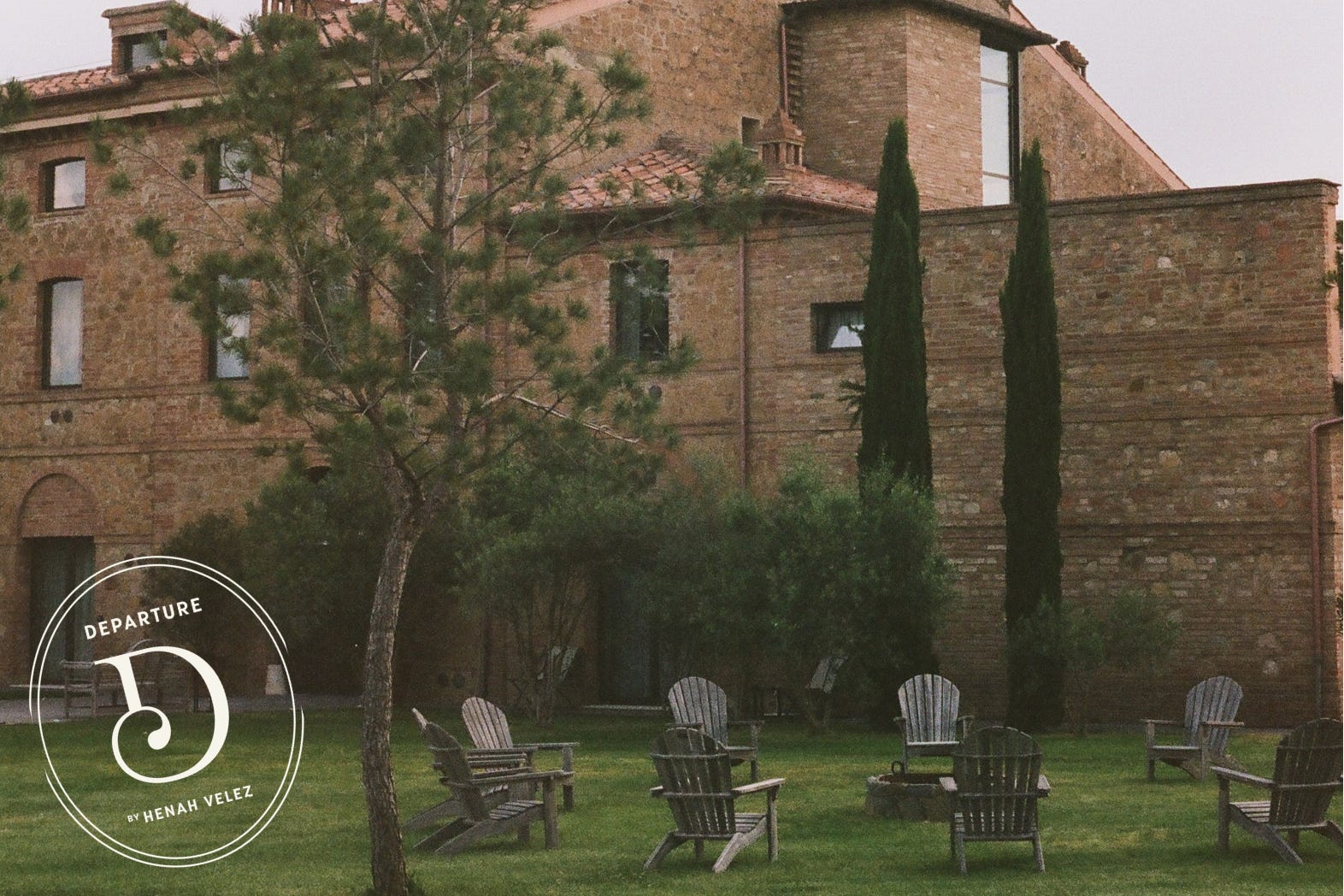
The days I spent in Italy were in the Tuscan countryside—lots of rich browns and olive greens, wild horses and birds, hours without seeing other humans. It felt restorative and peaceful in a way that’s hard to find at home.
Many of the retreats I’ve read about often take place in tropical destinations, leaning into the jungle and waves on the beach. Laura Hamm of Unplugged Travels, for example, hosts her digital detox retreats in Costa Rica: “There’s something about the soft yet vibrant jungles of Costa Rica that immediately feels immersive, welcoming, and alive. The forests and rivers seem to reconnect us with something more ancient and instinctive in ourselves, something that’s still there, no matter how disconnected from it we’ve become.”
I wondered if one environment might be more impactful than another, but across the board, it came down to locations that value stillness and nature rather than a specific kind of place. And, as Kristin Graham, a facilitator and podcast host focused on brain science, gently reminded me: One person’s restoration can be another person’s agitation. For me, being around large bodies of water for too long gives me anxiety, whereas neutral colors and gentle wildlife feel like home. It’s more about your specific needs, than the landscape itself.
Interestingly, Dr. Grojean also spoke to the importance of the horizon, which felt worth mentioning: “Environments with long views seem to interrupt the near vision which the smartphone has trained our eyes to expect, and this has a remarkable effect on how we process information—similar to a change in arousal. Mountains are especially effective for this purpose, which is why the view from my cabin in Montana is my favorite part of the retreat. The Pacific ocean may be even better, but any enclosed valley is substantially better than nothing.”
Experts acknowledged that our surroundings directly influence our state of mind, so it’s about exposure to nature that takes you away from your everyday environment, lowers stress, and improves your sensory experience—whatever that means for you. That could be a place with less noise, no commute, or more daylight. This also means, and this is worth saying explicitly, that the same retreat held in two different places can also often have completely different experiences, and that shift in energy matters.
4. Recovery from burnout is different for everyone, but there seems to be a general pattern.
Burnout is most prevalent in high-performing professionals who’ve been operating the same way for years: overachieving, people-pleasing, perfectionism, and taking care of everyone around them. (She says, as she checks all four boxes for herself.) So, yes, the sustainable changes you make will shift the patterns that drive burnout in the first place.
But what shifts first when you slow down? Between brain fog, irritability, a lack of quality sleep, and so on, what “release” happens first? There’s the exhale we spoke about around the day two and three mark. That moment of breathing again, and maybe even awareness and recognition of how tired you’ve been or how much you’ve been carrying.
Some experts also said that crying is a natural reaction after moving away from survival mode and getting permission to feel what it’s been suppressing. Dr. Grojean expounds, “When people have been depleted for a while before the retreat, their grief response is going to be stronger than their joy response [...] and so they begin to cry more easily on day three—over birds, smells, the kindness of strangers—as their range of emotional response returns to normal from below the usual baseline.”
She also shares that sleep and irritability are the other things that return first, and that “irritability follows sleep by about 24 hours.” What takes a bit longer is the motivation, cognitive clarity (or generally executive functioning), and trust in ourselves and letting go of guilt for needing the break. Laura P. also touched upon this: “[W]hat I'm still recovering from now and learning to hear is my sense of self—and this seems to be the longest to recover (for me, anyway). Call it internal voice, intuition, source, etc. In my burnout, that voice was squashed to the ground, buried under apathy and nihilism and ‘it's just what I have to do’ expectations. I'm still trying to heal enough to find a happy medium and trust that I can figure out what I want to do with my life.”
I also found this to be true on my trip—though Kristin pointed out that these symptoms can also be indicative of perimenopause or menopause, so it’s worth digging into. Amber echoed this as well: “My clients are typically over 40, and since burnout and perimenopause often have the same markers, what is showing up as burnout may actually be a hormonally-driven symptom.” If you’re not sure if this may apply to you, she recommends a symptom journal that you can share with your doctor.
5. You don’t need to leave your phone behind, but…you might want to.
Our addictions to phones isn’t a secret. We’re fed constant news and ads, trained to endlessly scroll, and made to feel always available and on; that’s a lot of added noise for our already overworked and overtired brains, especially for women who are often needed by others.
The second you might leave your phone behind while you walk out onto a beach or for a walk, your thoughts may still be circling back to the emails you need to send, or the errand list you need to update—the natural pauses that once existed in our day have vanished.
Laura at Unplugged Travels specifically curates tours around digital detoxes, anticipating all of the usual pushback of why we might need our phones on us: “What if something happens? What if someone back home needs me?” Her team builds that support into the experience: “Guests have daily check-ins and on-call emergency support via a ‘dumb’ phone, while there is also always a third party who can receive urgent communications from home and reach them if necessary.”
And yes, giving your phone away or leaving it locked up can be uncomfortable—but it can also build the muscle to return home without defaulting right back to the screen, similar to those aforementioned microsteps: “Before leaving, guests are encouraged to set specific intentions for what they want their relationship with technology to look like at home, whether that’s using a screen-time tool, experimenting with a dumb phone, keeping phones out of the bedroom, or protecting regular periods of completely screen-free time.” Something Laura said in our call was that it’s not really about unplugging forever—it’s about reclaiming the choice to.
If you do want to keep your phone on you, experts recommended a compromise: Leave your phone in your room so you can be fully present as much as possible; have a designated phone number for emergencies so you don’t need to feel “reachable,” and have one person (ideally hired by the retreat, not an attendee) be responsible for capturing footage throughout the experience. Instead of using the phone as a proxy for the real witnessing, as Dr. Grojean puts it, you can enjoy the time directly. (Might I also suggest a film camera as an alternative way to capture memories?)
I was curious if it was actually possible to integrate less screen-time into our lives upon returning, so I asked my friend Rachael who’s been on several retreats: “Retreats really helped me understand the value of me-time and also the toxicity of constant screens. They helped me recognize the power of simple routines like not looking at a phone until I had breakfast or walked outside for the day, also creating good habits like a daily journal or charging phones in another room instead of using one as my alarm clock. These were all changes to my routine that I was able to bring home with me and keep as part of my daily routine to ground myself when the noise came back in […] Anxiety had destroyed my sleep pattern, and being able to log out of all the accounts I managed, the Slack I was part of for work, and in some cases, my personal accounts, really helped quiet the noise and voices that kept me up at night.”
6. Stillness is a luxury. But you don’t need an expensive retreat to access it.
The last question I asked every expert: Is slow travel going to continue to be a trend, in a world of burnout? Most responses emphasized that slow travel feels more like a correction than a trend—a way to pare back against decades of maximalist itineraries and visiting 10 cities in two weeks.
In some ways, this feels obvious. Kristin mentions, “There’s growing interest in sleepcations, wellness travel, digital detoxes, and slower itineraries that embrace stillness, quiet, sleep, the delicious lazy feeling of waking up without an alarm, time with no agenda, a day that unfolds as it should, or a restaurant that fills your mind as much as your belly.” (You could say I was ahead of the curve!)
In fact, the wellness tourism market is projected to be worth over $1T (that’s trillion), and retreat hosts said they’re seeing Gen Z and younger millennials seek these experiences out earlier than their Gen X counterparts, more acutely aware of burnout. Kristin adds, “One generation is trying not to inherit the burnout model; the other is trying to unlearn it.”
But if you can’t get away—which is an honest conversation we need to have, about privilege, luxury, and the wealth gap around travel—how can you still reap the benefits of a recovery or reset retreat?
It comes down to those microsteps and grounding exercises, or, as Dr. Acquaviva aptly put it, savoring: “Savoring, the ability to notice and consciously prolong a positive moment, can transform a simple gesture [...] into a more vivid and meaningful memory.”
So even if a getaway to decompress isn’t on your horizon any time soon, hopefully you can still find a way to pause and breathe daily—in the moments you walk from your car to your front door, a ten-minute walk without your phone, or noticing an emotion before reacting to it. Stillness is, ultimately, free.
I want to close today with this story Laura P. shared with me, one that marries the beauty of travel, feeling grounded, and recovery all together: “My retreat group did a meditation underneath one of the big arches in Arches National Park, and our leader talked about how the rock formations in Moab took millions of years to form, giant pieces carved by the environment and falling away, leaving something beautiful and powerful in its place. And then, we'd look over the vast cliffs and valleys of Canyonlands [National Park], and understand just for a moment, that our problems are not as big or as vast as we make them to be. In the Catskills, being in the woods was the perfect backdrop for all of us artists suffering from creative burnout; we were invited to be still and hear nature's music being created, see the landscape change with the weather, or observe the animals strolling through the woods and understand that we're among them and of them. The lessons are always that if we can look at how we are nature, we can look at ourselves differently, and every environment can teach us something.”
And isn’t that the primary goal of slow travel, after all?
💰 If you’re planning to book flights over the holidays but are antsy about the price, it’s a good time to remind you about Sky Key. Sky Key auto-monitors your flights for you and if the price drops, they’ll rebook you and refund you the difference after a 25% cut of savings. For full transparency, Sky Key was an earlier sponsor but this mention isn’t sponsored; they simply saved me $100 on an upcoming trip last week (so a net savings of $75) and it reminded me that you don’t have to wait for the best price anymore. You can just book early to make sure you have a seat on your preferred flight and let the price savings roll in.
📲 Fun fact: I haven’t carried a wallet in years, because I only use a variation of this phone case—it makes traveling a whole lot easier, too. Enough room for your ID and favorite credit card.
😭 For your next long drive: The third act of this This American Life episode made me tear up on our recent trip home from Florida. Please do yourself a favor and listen.
🇹🇼 R.F. Kuang, author of Yellowface and new release Taipei Story, shared her favorite places in Taipei. Coincidentally, several of them were on my own list, so I trust her judgement, especially if you’re also a vegetarian. The Five Favorite Places series is always a fun read. (New York Times)
🌍 Lonely Planet’s hiring a remote Senior Social Media Manager, with up to $120,000 in compensation and flexible PTO.
If you enjoyed this week’s deep dive, I’d love if you could give this post a “heart.” It goes a long way for the platform’s algorithm, and helps me grow. 💕 See you next week! —Henah x
The retreat creates the pause, but integration is what makes recovery stick. Thoughtful programs must design beyond checkout with practical tools, follow-up and community, otherwise we’ve simply put burnout on vacation. Having been to an amazing property earlier this year that provided no re-integration or follow-up support; I feel this!
I would also recommend that people with a corporate job look into what kind of leave options their company has. One of the things burnout does is convince you that you absolutely CANNOT take any time away, but it is waaaayyy more common than you realize to take a month or two off.