
Slow, quiet travel has always appealed to me—but it’s ultimately only one branch of a much larger ecosystem rooted around slower living. For years, I worked at The Good Trade which focused on slow, ethical, and sustainable fashion. And I think, maybe unexpectedly, there’s a generous overlap between slow fashion and slow travel; a thread (literally and figuratively) to pull at.
The philosophies are similar: If you believe your life can be enriched with deep, local, and extended travel, the same can be said about investing in handmade or eco-friendly clothes that are made to last.
So even if you opened this email and thought, "Huh? What does this have to do with travel?” I’d encourage you to read today’s edition in full—I think you might be surprised. (And our guest has some exceptional advice for your next trip, too.)
I’m honored to have Karuna "Ku" Scheinfeld, co-founder of Four Objects, join me today. Four Objects is a certified B-corp that makes incredible women’s clothes with ethics that are hard to find elsewhere (and I promise I would know after eight years of researching sustainable brands!): mindful sourcing, biodegradable materials, fair labor practices, circularity, local manufacturing, and 4% back to your makers. Four Objects carries a capsule collection of chic essentials, ones that are actually perfect for travel; I recently brought one of their silk shirts to France, and it was a dream.
Without further ado, here’s my engaging conversation with Ku—I hope you enjoy.

Through August 31st, annual subscriptions are on sale for $35. Paid subscribers receive exclusive access to giveaways and the archive. Thank you for your support.

Ku, thank you so much for joining us on Departure. Can you share a little bit about Four Objects and your philosophy?
Four Objects was really born out of decades working in apparel in the fashion industry all over the world. I had carved a career out of making product that had longevity and was well-designed and high quality, but I was still creating thousands of new styles per season, per year.
This was coinciding with a lot of work in sustainable product development, as I was learning more about how agriculture and fabrics were tied, and really thinking more about the next level of where the materials I was choosing was coming from. I was making those changes in a corporate environment. But everything was a fight, and I had to really work hard to even scratch the surface. So Four Objects came from this desire to start over and say, “Okay, how do we make not very many things, make them really well, and not change them every season?”
What are the things that we want to have that we’ve had in our wardrobe for decades that inspire us, that we want to keep wearing and that we keep going back to? What if we make those things and think all the way back to the material source, and think about how that material is processed and made? What if we know who’s making our garments, and we actually have a relationship to their community, and we talk to them about what they need support with, right?
So it was all the things I didn’t have support in a corporate, highly scaled environment to do that I wanted to try. It all became a bit of an experiment to try to figure out: Is this viable as a brand in a capitalist setting? Can I make a profitable brand out of this, right? What does that look like and what do we have to do?
We’re still in the process of that experiment. We’re still building it, we’re still refining it. The brand will grow and evolve through that same design philosophy where you want beautiful, high quality, thoughtfully made things. And if you get great stuff, you don’t need a lot of it.
It’s interesting timing, because one of my favorite slow fashion brands actually recently announced that they’re shutting down. It’s probably the fifth slow fashion brand I’ve seen shut down in the last two years. Do you think that’s simply the cycle now? Or is it telling of a bigger issue that you are also trying to navigate? You’ve been in the industry a long time and it’s really disappointing to see we had that shift towards sustainable fashion and now people care less about it again.
I love what I do—but fashion has one of the highest failure rates, period. It’s hard to start a brand. It’s hard to have a successful brand and maintain one when you have to create inventory that’s in sizes that you make nine months ahead of time sometimes.
In addition to that, we are in a moment in our global economy where the middle is disappearing. So you’re either considered tiny or huge, and surviving in the middle is very hard. Yet that’s where there’s still so much opportunity, so it’s a strange dynamic. I have to believe that’s a phase.
Our customers are really smart women. That is our demographic consistently: It’s not their age, it’s not their race, it’s not their income, it’s their level of education. So the women we’re speaking to, they’re thinking, and they’re looking. When they find a brand who is doing a lot of that work for them and you build trust, there’s something very powerful there.
The human part of it is really important. Not only are customers loving what we do and building that loyalty, but the makers, too. If I have a great relationship with a maker and they trust me and I trust them—it’s not just a business relationship.
This is a tough moment, but I’m very focused on carrying us through this moment, because I think in the not too far future, we’re going to have more tailwinds, especially for people who are thinking and doing things differently.
You have this really moving story about friendship and travel with one of your products, and I’m actually wearing the BF Tee as we talk. Can you recap that for the audience, and how it celebrates both a thoughtful closet and of craft?
When we were in university, [my co-founder] Mae and I were roommates and we were living together in downtown New York—we had found really cheap rent down by the Financial District. And Century 21 was right there, with all the offloaded designer product. As a fashion student, it was the place I went to shop because that’s the only place I could afford my favorite designers.
So I bought this Maison Margiela t-shirt that was amazing. I wore it all the time, and one day, it just disappeared. When you’re 20 years old in university, you have parties, you have friends stay over, you never know where things go.
About 15 years later, Mae admitted to me that she had stolen the T-shirt, and she had taken it on her motorcycle tour around India. She’d worn it to shreds; it was like a rag. But she’d been carrying it around with her for decades, because she was intending to get it remade and to give it back to me.
It was the perfect item to include in the collection because now we could remake it together. So when we remade it, it wasn’t a carbon copy, and we had our own spin on it. But we remade it with our partner in Peru, from this beautiful organic cotton that’s been grown there for thousands of years, with a female-owned company that has its own foundation internally that we donate to. It was such a beautiful full circle moment.
What a gift to now have a product you’ve co-created. Let’s talk Brooklyn. You’ve lived there for years, and Brooklyn has really had a revitalization the last 10–15 years. What’s your idea of a perfect day in the borough?
The first thing that comes to mind is the Brooklyn Botanical Garden. The care and the thoughtfulness that goes into BBG, just getting lost in there, I can spend hours in there and not be around crowds. So anybody who loves being outdoors when you’re in the city, I love Brooklyn Botanical Garden as a little bit of a haven to immerse yourself in nature when you’re in Brooklyn.
Our neighborhood treat is doubles (a Trinidadian street food), so there’s a place called Trinidad Golden Palace on Nostrand. The thing is, is they’ll run out of doubles. If you get there too late in the evening or the afternoon, you won’t get any. But I don’t think you can find a better one in Brooklyn.
We started a program at the beginning of the year of our seamless Merino sweaters. But there’s a factory that makes them in Brooklyn, called Tailored Industry. They’re in Industry City, so I’ve been spending a lot of time in Industry City in the past year and it has blown up. Industry City is absolutely worth a day trip, especially if you don’t want to feel like a tourist: You can get incredible food (especially Japanese), you can go to an escape room, you can buy outlet-priced furniture at Design Within Reach. I bring my kids to the anime store, and then we go get pastries at Colson Patisserie. There’s a chocolate maker and a brewery there. Industry City to me is the coolest spot to spend a day and explore.
Any Brooklyn-based makers, shops, or founders you’d want Departure readers to know about?
We’re actually looking for more brands to collaborate with; we started this program last year where we do quarterly brand partnerships. So with our Collector subscription, you get four pieces a year and you are automatically sent something every three months. We started that because we didn’t want to build the business off of discounting. That’s one of the really unhealthy aspects of the fashion business, and most people have been trained to wait for discounts when they purchase.
But there are other kind of perks we want to provide, right? We want to provide exceptional customer service and returns and exchanges. When you’re a Collector, you have four months to try something and you can return it and get a full refund if you’re not happy with it. But I also wanted to kind of give our Collectors presents. So I thought, why don’t we find four brands a year that we think are fantastic? And every time you get your subscription item, you get a little gift. Even if you don’t keep the item we sent you and you return it, you still can keep that gift—that’s yours to keep.
So I’ve been working with brands all over, but I’d love to do more local brands. They need to align with our values. We have to feel confident that that’s happening. But now I’m constantly on the hunt for cool adjacent brands that we can work with.
I love that you’re making it more of an experience and relationship; I don’t just feel like an order number that way. I care about who the brand team is as well as the maker.
That segues nicely to my next question: Prior to running Four Objects, you worked with a number of fashion brands, and that took you to family-run studios in places like Veneto and factories in Guangzhou. What’s a habit or ritual you picked up from that kind of travel that you still use today?
Everywhere in the world, there are people who care deeply about what they’re making, whether they’re chefs, artisans, or selling popcorn on the street. You find them everywhere. So to me, I’m not that interested in the big scaled experiences. I’m really looking for small personal experiences where people are personally invested in what they’re making or what they’re cooking or so on. And that comes mostly through friends or people on the ground.
One of the first things I always do when I’m traveling is: Whether it’s somebody I’m working with or I’m talking with anybody I know, we’re talking about their favorite thing there. It’s almost this process of extracting people’s passions. The most exciting thing is when they don’t really know at first and the more you talk to them, you find out what they’re really into and then they introduce you to something you never would have found.
When I went to Tokyo years ago, I was doing a collaboration with a brand called Snow Peak, an outdoor camping brand. We took a train to their headquarters, which is a few hours outside of Tokyo and the countryside. I had talked to our contact there ahead of time, and he was going to arrange food for us. I asked, where do you guys go to lunch? Can we go there on our way in? And he said, oh, it’s very small, you won’t like it, it’s very—the word he used was homemade, but with a negative connotation. But I was like, perfect, that’s where I want to go.
He took us to this woman’s restaurant, inside of her home. It was a five-seat counter in her garden out back. To this day, one of the best meals I’ve ever had in my life. If we hadn’t opened up that more personal conversation, he wouldn’t have considered that professional otherwise.
So sometimes it’s important to peel back that professional veneer to get to something more human and more personal. It’s not always the best meal of my life, but it’s certainly interesting and more interesting to me than the nicest restaurant in town.
Definitely, and I love that concept. Similarly, when you travel now—whether for work or personal reasons—how do you decide which places are worth slowing down for? Or, if every city has a worthwhile destination to drop by, how do you choose?
Instead of there being a specific restaurant to go to, I find that I’m building in this open space where I find a place I want to go and experience—so that may be a garden or a museum or something that’s more cultivated—and I just talk to people there.
Because the assumption I’m working off of is that the people who are involved in this space, whether it’s an art gallery or community space or a beautiful garden, they’re probably going to have some overlap in interests and tastes with me, right? And then I’ll leave space to ask them what they like to do, where they go. You develop this instinct for the person who you can tell is going to get excited about it. Or you’ll talk to one person and another person will be listening in and they’re like, he doesn’t know what he’s talking about. You need to go here.
It’s really relating to people on the ground as much as possible and talking to people. I feel like it’s a bit of a lost art. Everything’s pre-planned nowadays because we have so much information. So now, the luxury for me is to play it by ear and have a conversation.
That’s such a fun “mind map” way to experience the world, and probably makes for a more local experience. Shifting to fashion and travel: Your creative process is inspired by the concept of the “16 things you want to keep and wear forever.” I’d love to know: If you could only bring one carry-on bag, what would make it into your packing?
My lens is I’m often moving from spaces like Paris and Milan to spaces like off-grid Ontario camping, right? I don’t like to have to change everything between these spaces. I like these things that live between all these spaces because they’re actually basic in the sense that they function really well, they’re high quality, and it kind of doesn’t matter where you are:
Merino is my favorite travel fiber, for a few reasons. It’ll keep you cool when you’re warm, and warm when you’re cool—it’s very temperature regulating. It’s antimicrobial, so you have to really work to make it smell. The wrinkles shake out. I don’t want to have to wash things a lot. I don’t want to have to carry around stinky clothes while traveling. And I want to be flexible, whether I’m aiming for casual or dress up and not have it feel like a separate wardrobe.
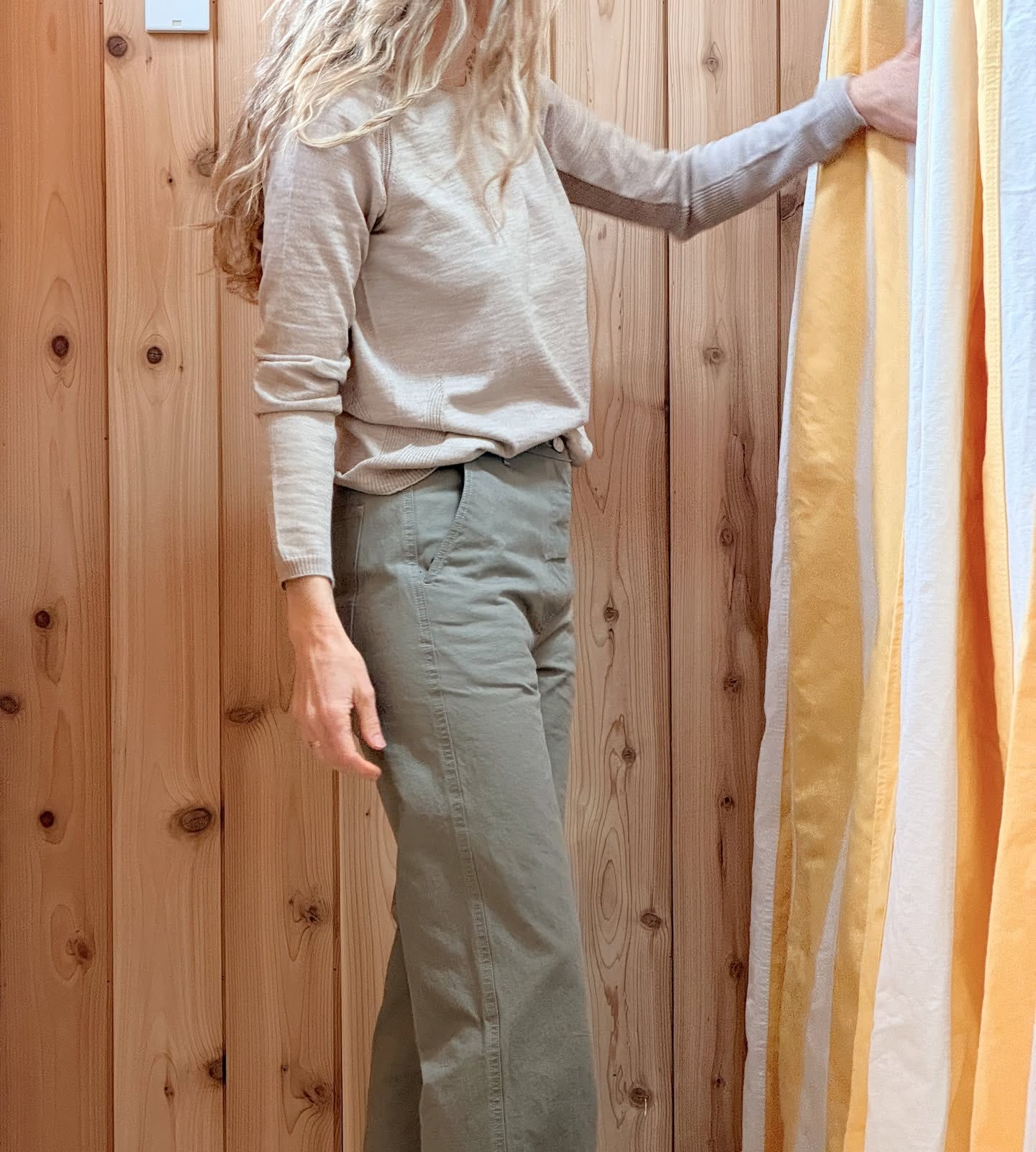
What I’ll wear on the plane without fail is: I’ll wear our seamless merino long sleeve as a base layer, and our blazer on top of that, which is organic cotton and merino, but it’s a knitted fabric so it looks like a blazer, feels like a sweater. The pockets are big enough for my passport case and my phone, and there’s a secure interior pocket to keep things accessible right on me.
Our trousers are a beautiful, lightweight, super-fine merino wool, and we designed the waistband with pull tabs so that the waist can change size. You can wear it more open, can wear it higher up on your waist and tighter—or looser, also depending on how bloated you feel, frankly, which is not sexy to talk about. But when you’re traveling, it really matters.
I am really, really loyal to PRATIMA Skincare. She’s an Ayurvedic brand in New York. And I travel with everything I use at home. The size of it works, the process works, my needs work. Pratima has these skincare little packs based on your dosha. They’re really my go-to; I can’t go anywhere without them.
I have a thousand versions of Merino socks that I wear everywhere and for every occasion—those are really critical for travel, too.

You’ve had a front-row seat to talented artisans, natural fabrics, and what it means to really know a craft. If someone wanted to travel the way you have—not for a vacation, but the kind of trip that actually shapes how you see that labor and craft—where would you send them?
Italy and France. The tradition and the commitment to craftsmanship is really powerful. It’s part of the culture in a way that’s so tangible between made goods and food—that’s what it’s all about, right? I still think you can have incredible experiences in Italy and France, even though they’re very popular, touristy destinations.
I feel the same way about Japan and Tokyo; I’ve been too many times, but I’m planning next year a trip to spend some more time in the countryside. And that’s really what I want to explore and slowly.
Other than that: Peru. People go to Peru for Machu Picchu, but Peru has incredible traditions that are thousands of years old, the dyers, and especially if you’re into textile arts, and the family-owned artisanal work in Peru is incredible. It’s really fundamentally based in alpaca and cotton.
I have this one shawl that I bought there years ago, that is all hand-dyed with natural dyes. And it’s 14 colors. It’s vibrant, it’s beautiful, it’s incredible. It’s not what you think of when you think of that description. You would never know that these were all hand-dyed with available materials, and it’s knowledge that is really sacred and that’s really special, and very few people even have anymore. I actually think Peru from an artisanal perspective is an incredible place to visit.
In the last year, I’ve felt very drawn to returning to places I’ve visited before. Four Objects has a similar ethos: Pieces you can return to again and again. Do you feel that same pull when you travel, instead of perhaps chasing somewhere new?
I am so torn between wanting to see everything in the world and wanting to have my place and stay still, and so I’m finding a relationship between those things. I have two places that are my places and I will return there with my family for the rest of my life.
One of those is our home in Brooklyn and the other one is our home in Ontario, on an island on a lake. When we’re there, we don’t have screens and the kids are completely disconnected. It’s a couple of months a year where we’re living a really different life. We could explore there, even in that small part of the world.
There’s something about coming back to the same place and laying down roots where you see how the ecosystem changes every year. One year, there’s this incredible plethora of 15 varieties of mushrooms, and the next year there are no mushrooms. Then you see a bald eagle and then you don’t see another one for three years.
Aside from that, it’s the relationships. It’s getting to know people who’ve spent their lives there and learning from them and learning how to catch fish in the lake and then immediately do the perfect fry up on the side of the boat. That’s the most amazing fresh fish you’ve ever tasted, right? I learned that from people who’ve been doing that for three generations on our lake.
I really need both. I need those places we keep returning to where we can just learn more and the simplicity of really going deep somewhere. Then I also want to explore and I want to see things I’ve never seen before. There’s too much to do it all. The incredible privilege that we have is that tough decision: Where do you lay down your roots? And then each year, where are the places you go to explore? I’ve allowed that to be led more by my relationships than anything else.
That feels very full circle to me, too. Of you going to a place and asking locals, “What do you recommend?” And this feels similarly.
There’s also this sense of serendipity that I really believe in—let me give you an example. There’s an author, Diane Osgood. She found our brand, became a Collector, and reached out because she was writing a book on sustainable fashion. She’s now a very good friend. She has a beautiful home in the south of France, in one of the most beautiful regions of France. Mae and their family just visited her there to help her harvest. It happened because of this relationship, because of shared interests and shared values.
It all comes back to the same idea of rooting things in human relationships rather than it being information that we find and we sort and we filter. Because right now, we’re becoming less and less connected. We’re becoming more and more isolated. And these approaches feel like the answer to that for me.
It’s amazing what we can discover about any destination we’re going to online. But it’s not as satisfying as there being a relationship that brings us there or that opens the door to us. And then the ways you can discover things underneath that.
How do you build those connections, if you don’t yet have access to that network, or, frankly, the funds to make connections—or to purchase a home in another country?
When I was coming up in the industry, I traveled all the time for work because that was part of my job. I got to see the world because of my job, and I got to meet a lot of people. The ones I particularly connected with, we stayed in touch. And not serious touch, but you stay connected on social, you have each other’s email, and then we would send each other recommendations. That’s the positive thing about the connectivity we have now.
But when you open yourself up to that, and you invite people into your home that are one step removed—this is a policy that my husband and I have: If you’re a friend of a friend, you’re welcome in our home. If you need to crash in Brooklyn with us, even if we’ve never met you before, and we have done this many times, you can come crash in our home.
Because of that policy and practice, those connections all open up. It’s not a stranger. It’s not something dangerous, but it’s a willingness to go that extra step to connect with people, to allow people to come into your world to share. And then people are so generous back.
For someone who’s never really thought about slow fashion before but loves the idea of slow travel—what’s one mindset shift you’d want them to try?
Years ago, I decided I was going to shop differently. It wasn’t for some virtuous reason; it was because I wanted to buy really nice things and I couldn’t afford them. So I basically figured out how much I had spent on clothes the year before, and I gave myself a budget and permission to use that money in whatever way I saw fit.
When I gave myself permission to spend that budget however I wanted to, I bought much nicer things. And I bought fewer of them, but they did so much more for me. I was really careful, I thought about it and I paid full price for a lot of them.
So my advice is: Just think about it. Notice that maybe if you give yourself permission to buy yourself something really nice, and you give yourself a cadence and a budget that will work for you, you might be surprised about what you can get for less. I think it’s when we’re in a hurry, when we are under a lot of pressure, that we end up spending a lot of money for convenience that doesn’t last and doesn’t stay with us.
For new customers, the Four Objects team has shared you can use "NEW25" to receive $25 off your first apparel purchase.
🏆 The winner of last week’s giveaway for a $50 gift card is… Leda Derosa! DM me to claim, and thank you again to all paid subscribers for being here.
✚ One of my favorite points tools, PointsYeah, recently rolled out a Family and Friends Points Wallet which could be a game-changer for multiple card holders in one household. Some programs don’t let you pool points sadly, but at least you can see all available points in your family, instead of having to track them down disparately. It’s a Premium feature, but it seems they’re currently giving 25% off Premium with code WALLET25. (Not sponsored, just something I noticed!)
💁♀️ As someone with fine, oily hair, I usually have to wash my hair every single day. After years of testing dry shampoos, I think this one might be the winner. I regret to inform myself and all of you that the price is, in fact, worth it. Fits into your carry-on luggage, too!
🗺️ Google’s “Ask Maps” feature can now handle complicated, multi-step requests: “[Y]ou can also quickly discover the latest information about hotels and local events. Ask for what you need: ‘For next week’s conference in downtown Miami, find me a decently priced, top-rated hotel with an artsy vibe, within walking distance from a gym and restaurants.’” Anything to stop opening up 48 new browser tabs to compare.
🤔 We know that solo traveling as women comes with risks—but are “safety premiums” that cost extra to avoid harassment worth it? Is it even fair? (BBC)
See you next week! —Henah x